Can you drive an RV through Zion National Park? It is one of the most common questions RV travelers ask before a Southern Utah trip, and the honest answer changed on June 7, 2026. As of that date, large vehicles are banned from the Zion-Mt. Carmel Highway, the east-side road with the famous tunnel. If your rig is big, the route you may have planned no longer works.
That does not mean you have to skip Zion. It means you need to understand the new rules before you point your rig at the entrance. A wrong turn in an oversized motorhome can leave you backing out of a line at the tunnel while rangers wave you off. A little planning avoids all of that and still gets you a great day in the park.
This post answers the real question behind can you drive an RV through Zion National Park. It covers the new size limits and the tunnel rules that just changed. It also explains which roads still work for large rigs and how to plan a day visit when your rig cannot enter the main canyon. By the end, you will know exactly what your setup can and cannot do.
What the Rules Actually Say About Driving an RV Through Zion
Here is the short version. You can still bring an RV to Zion and enter through the South Entrance near Springdale. What you cannot do, as of June 7, 2026, is drive a large rig across the park on the Zion-Mt. Carmel Highway. That is the road that climbs to the east side through the historic tunnel.
A vehicle counts as large if it exceeds any one of these limits. The cutoffs are 35 feet 9 inches in length, 7 feet 10 inches in width, and 11 feet 4 inches in height. The weight limit is 50,000 pounds. For a truck pulling a trailer, the combined limit is 50 feet overall and 26 feet from hitch to rear axle. Go over any single one of those and you are banned from that highway.
The width limit catches the most people. At 7 feet 10 inches, nearly every full-size pickup with mirrors out is too wide, along with most Class A motorhomes and fifth wheels. Measure your rig with the mirrors, the awning, the AC unit, and any racks included. Folded mirrors do not get you a pass. If the widest point of your rig is over 94 inches, the highway is off limits.
The Park Service made this change after safety studies going back to 1989 showed that large vehicles cannot hold their lane on the tight switchbacks. The old escort system, where you paid fifteen dollars and a ranger walked you through the tunnel, is gone for good. There is no permit that gets a big rig through anymore.
The Zion-Mount Carmel Tunnel and Why It Changed
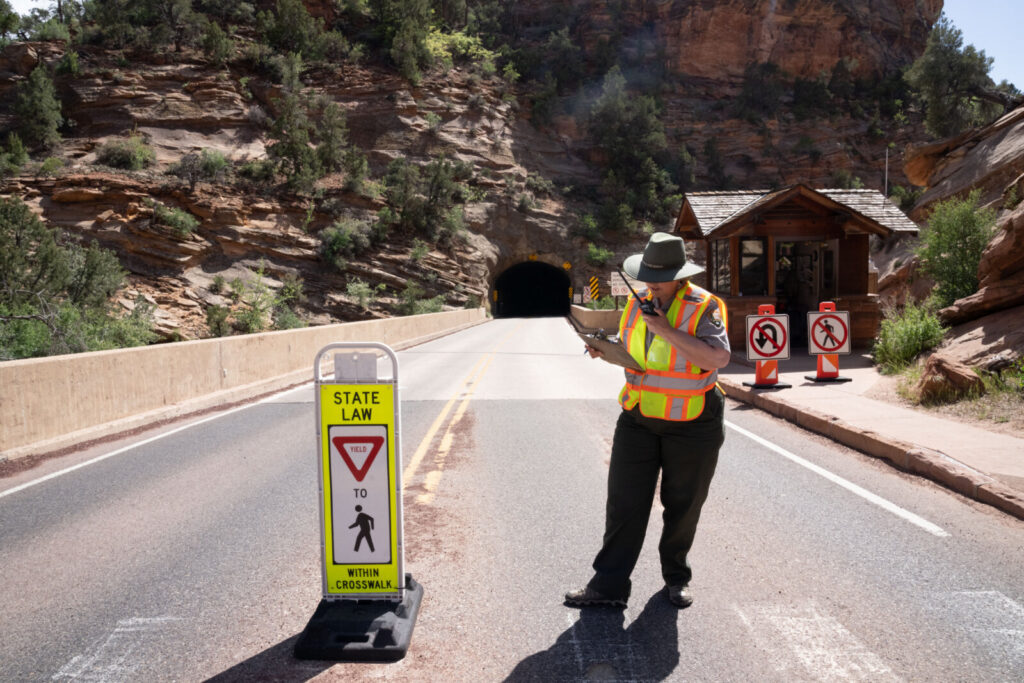
The tunnel is the heart of this whole issue. It runs 1.1 miles through solid sandstone and opened in 1930, back when the largest vehicles on the road were a fraction of today’s motorhomes. It is narrow, unlit, and carved with switchbacks that were never built for a forty-foot rig.
For decades, the park handled oversized vehicles with an escort. Rangers would stop oncoming traffic and let big rigs straddle the center line to clear the tunnel walls. That system worked, but it created long backups. The park found that during peak periods, traffic flowed freely for only about nineteen minutes out of every hour. The rest was spent escorting large vehicles one at a time.
That is the bottleneck the June 2026 ban was designed to fix. Compliant vehicles under all the limits can still drive the highway and pass through the tunnel normally. Oversized vehicles now have to turn around at Canyon Junction on the west side or at the East Entrance. There is no longer a way to take a large rig from one side of the park to the other.
If you are heading to Bryce Canyon or the Grand Canyon North Rim after Zion and your rig is oversized, you need a detour. The Park Service recommends paved state highways for these trips. For Bryce, take I-15 north to Highway 20, then US-89 south. For the North Rim, take Highway 59 toward Jacob Lake. These routes add somewhere between ten and forty-five minutes, which is a small price compared to getting turned around at the tunnel.
Which Roads Work for RV Travelers and Which Need a Tow Vehicle
Not every road in Zion falls under the new ban, so it helps to know which is which. The Zion-Mt. Carmel Highway on the east side is now closed to large vehicles. The Zion Canyon Scenic Drive, the main road into the canyon, is closed to all private vehicles during shuttle season regardless of size. That season runs March 7 through November 28 in 2026.
The good news is that Kolob Canyons is wide open to RVs. This is the quiet northwest corner of the park, reached directly from I-15 exit 40. The five-mile Kolob Canyons Road climbs to a stunning viewpoint with no tunnel and no shuttle. You drive it yourself in your own rig. It is the single best option for an RV traveler who wants to see dramatic Zion scenery from behind the wheel.
For the main canyon, plan to leave the big rig behind. During shuttle season, even a compliant RV cannot drive the Scenic Drive. The free Zion shuttle is the only way in, so the size of your rig does not matter once you are past the Visitor Center. Our Zion shuttle tips for RV travelers post covers how to time your day and where to park.
This is where a tow vehicle earns its keep. If you travel with a car or truck behind the motorhome, you have an easy option. Leave the rig at your resort and drive the smaller vehicle to the park. That gives you the most flexibility for parking and for the east-side scenery that your RV can no longer reach. If you do not tow, the shuttle and the park-and-ride options below fill the gap.
Planning a Day Visit When Your Rig Cannot Enter the Canyon
The cleanest plan for a large rig is to base it outside the park and ride in. There are several good RV parks near Zion National Park along the Washington and St. George corridor with full hookups. You set up once, leave the rig on its site, and drive a tow vehicle or catch a shuttle for your park days. No tunnel worries, no parking scramble.
The new Park and Ride in Virgin makes this even easier in 2026. It sits about thirteen miles west of the park and has eight oversize spaces built for RVs and trailers. Parking is free, and a shuttle runs into Springdale for five dollars per ride. From there you connect to the free town shuttle that drops you at the park entrance. If you must bring the rig closer than your campsite, this is the place to leave it.
Inside Springdale, remember that any vehicle over twenty-four feet cannot park on Zion Park Boulevard. Those rigs go to Lion Boulevard instead. The Visitor Center lot has a few oversize spaces, but they fill between eight and nine in the morning during peak season. If you want one, you need to be there early. The entrance fee is thirty-five dollars per vehicle for a seven-day pass, and the America the Beautiful pass at eighty dollars covers it.
Once you are in, the rest of your day runs on the shuttle. Ride to the Temple of Sinawava and walk the Riverside Walk. Hop off at Zion Lodge for the Emerald Pools, or start an early climb if you hold an Angels Landing permit. None of the Zion National Park attractions in the main canyon require your rig at all. They require a shuttle seat and a good pair of shoes.
Making Zion Work for Your RV in 2026
So, can you drive an RV through Zion National Park? You can drive it into the park from the south side, and you can drive the whole Kolob Canyons road in any rig. What you cannot do, as of June 7, 2026, is take a large vehicle across the Zion-Mt. Carmel Highway and through the tunnel. That route is closed to oversized rigs for good.
The plan that works comes down to a few moves. Measure your rig honestly, including the mirrors. Base it outside the park or at the Virgin Park and Ride. Use the shuttle for the main canyon, and save Kolob Canyons for the day you want to drive yourself. If you are continuing to Bryce or the North Rim, map the paved detour before you leave. Rules can shift mid-season, so check the park conditions page the morning you travel.
If you want help planning a Zion trip around your specific rig size, the Settlers Point team is glad to walk you through it. Reach out before you book so we can line up your base camp, your park days, and your route. Or drop a comment below if you have driven the new setup and have a tip for other RV travelers.
What are the size and weight limits banning large RVs from the Zion-Mt. Carmel Highway?
As of June 7, 2026, vehicles over 35 feet 9 inches long, 7 feet 10 inches wide, 11 feet 4 inches tall, or 50,000 pounds are banned. For a truck pulling a trailer, the combined limit is 50 feet overall and 26 feet from hitch to rear axle.
Can I still bring my RV into Zion at all?
Yes. You can still enter through the South Entrance near Springdale, and Kolob Canyons Road on the park’s northwest side is open to RVs of any size, with no tunnel and no shuttle required. What’s closed to oversized rigs is the Zion-Mt. Carmel Highway on the east side.
Is there still a tunnel escort permit for large RVs?
No. The old $15 escort system, where rangers stopped oncoming traffic so a big rig could straddle the center line through the tunnel, ended permanently on June 7, 2026. There is no permit that gets an oversized rig through anymore.
What should I do if my rig is too big for the tunnel?
Base your RV outside the park and use a tow vehicle or the shuttle for the main canyon. If you are continuing to Bryce Canyon or the Grand Canyon North Rim, take the paved detour: I-15 to Highway 20 to US-89 for Bryce, or Highway 59 toward Jacob Lake for the North Rim.